24.03.25
Beth Shalom trip for year 9
On the 27th of January 2025, Year 9 went on the annual Beth Shalom trip on the 80th anniversary of the liberation of the most infamous Nazi concentration camp: Auschwitz. I was part of the trip and would like to share my view on how the experience was. Undoubtedly, the highlights of the trip were the museum and getting to hear Arek Herschel, an Auschwitz and holocaust survivor, talk about his arrival to the camp.
The museum, I found that this was the most immersive experience of the whole trip. We saw many short documentaries talking about Jewish life during the holocaust as well as many sets and artifacts from the time, making you feel as though you were in late 1930’s Germany. The maze-like structure of the museum also helped in creating a sort of unexplainable atmosphere in my opinion.

This is one example of something that I wasn’t aware of before the visit. I talked to another pupil of year 9 who visited the centre and this is what they thought about the centre:
“The Holocaust centre was pretty good, it had lots of facts and was an engaging and a very immersive experience. Even though I enjoyed it, I would not likely return even with the new rose blooming ceremony, mainly because it’s too far for me to go. Overall, the tour was nice and I particularly enjoyed listening to Arek Hersh and his own experience at concentration camps as it gave me a new perspective on the matter. I was incredibly happy when I found out that this may have been one of the last times that we could have a survivor talk to us.”
As the interviewee said, we got to hear the story of Arek Hersh from Arek himself; this is undoubtedly a once in a lifetime experience and it felt even more special due to the fact that it was on the 80th anniversary of the liberation of Auschwitz. The questions asked were interesting ones and painted a picture of Arek’s experience. His story also showed the extremes that people had to go to save themselves from being immediately killed, such as in Arek’s case, where he lied about his age. He also talked about the conditions of the huts they lived in and the tattoos he received while at Auschwitz.
These two were the most memorable parts of the trip, however, for me there was much more to the trip than just this. Something that I found very memorable was the nature-filled setting of the centre. It felt a lot like a garden as the memorial centre was filled with rows of growing roses and plaques put in memory of Jews that suffered due to the holocaust.

The final part of the trip was a discussion on conspiracy theories, most notably those made about jews both in the past and in the present day. This was an interesting discussion, although in my opinion, the least interesting part of the day.
Overall, I think that the trip to Beth Shalom is a thought-provoking and immersive representation of the persecution of jews during world war 2, with many interesting locations, art pieces and artifacts that portray the history of the holocaust.
Image source: https://www.holocaust.org.uk/
London drama trip
On Friday 14th March, Drama Students from years 9, 10 and 11 set off to London to enjoy an amazing weekend of theatre and fun. We got the train down there and headed straight to His Majesty’s Theatre where we saw the incredible production of ‘The Phantom of the Opera’. This is one of the longest running west end shows and it’s easy to see why it’s so popular. A particular highlight was the ornate chandelier which rose and fell throughout the show and loomed over the audience.
We then headed straight to our hostel where we collapsed for the night before getting up bright and early the next morning to head for a backstage tour round the National Theatre. This was an amazing experience as we got to see how the staging worked and was designed alongside how it was brought to life. We got to see the prop workshop and had an exclusive look at a revolving stage, which everyone found very impressive.
After the tour, we went to see our second show ‘The Play That Goes Wrong’ which was a laugh-out-loud comedy about an amateur theatre group who can’t catch a break. The disasters and jokes had us all cackling in our seats and everyone was grinning ear to ear by the end. We then went straight home on a coach from Trafalgar Square.
Geography trip to Iceland for year 10 and 11.



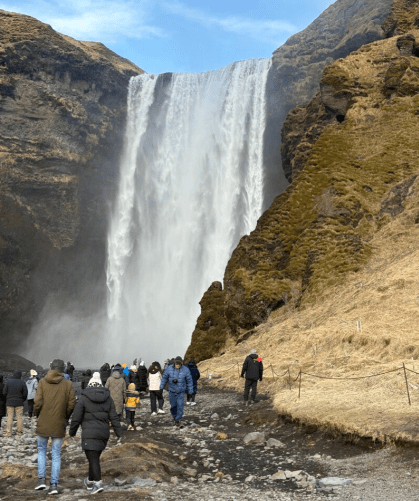
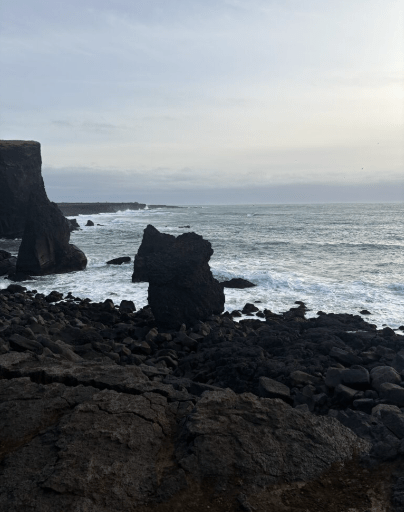


In February half term, myself and a small group of students from years 10 and 11 went to experience Geography first hand in Iceland.
The bus left school early on Saturday morning to Manchester airport. Our plane took off just before midday and after a smooth three hour flight, we arrived in Keflavik. We travelled straight away to the ‘Bridge between continents’ where a footbridge spans across a gap caused by the Eurasian and North American tectonic plates (and helps show the effects of continental drift). Afterwards, we made our way to Reykjanesviti which is Iceland’s oldest lighthouse, built in 1878. Gigantic waves crashed into the cliffs which made for fantastic photo opportunities. The area there is called Mount Valahnúkur, and was formed by a single eruption. The island of Eldey, a bird reserve, could be seen in the distance. Gunnuhver was our next stop, where you could walk near mud pools and steam belts. Gunnuhver is Iceland’s largest mud pool out of the many it features. These are created when steam from a geothermal reservoir condenses and mixes with surface water. Hydrogen sulphide is what makes the gas smell like rotten eggs! After a busy day, we then arrived at the 201 Hotel for a night and were treated to our first glimpse of the Northern Lights. Amazing!
First thing on Sunday morning we went to the swimming pools, which Iceland is very proud of. They are heated naturally, which makes it more pleasant than most other normal swimming pools. Afterwards, we travelled to Hellisheidi Geothermal station, the world’s sixth largest geothermal power plant, where we saw how Iceland gets its hot water and electricity. We saw the turbines converting the energy into electricity! It is sited on a high temperature geothermal area and provides energy for the capital. Following that visit, we then went to Seljalandsfoss waterfall as seen in the picture below. It is a 60 metre tall waterfall, and we were able to walk behind it!
We then took the bus to another waterfall called Skogafoss, which had roughly 600 steps to the viewing platform. It was the perfect place to see this impressive waterfall with single and double rainbows on display due to the sun and the spray.
Severe wind meant we weren’t able to do the glacier walk. However, we still walked near it to be able to see it but the majority of us got blown over! After the windy weather, we retreated back to our hotel, where later that night, clear skies meant another viewing of the Aurora Borealis.
On the third day, we went to the Secret Lagoon (another naturally heated pool) where we were able to relax and unwind. The natural hot springs created a magical effect with the rising steam and a small geyser that erupted every few minutes or so. After that relaxation, we travelled to Gullfoss waterfall and gorge, which was absolutely massive! The gorge was formed by a flash flood which forced its way through the cracks of the basalt lava layers.
We then went to the location of Geysir, an erupting hot spring that gave its name to all of the world’s geysers. It is one of the natural wonders featured on the Golden Circle.
Following that exciting visit, we went to Thingvellir National Park where the oldest parliament in the world was established, in 930 AD. It is a rift valley being formed where the Eurasian and North American tectonic plates drift apart. In the distance, we were able to see a shield volcano!
On Tuesday, we headed on the bus for a few hours up to Grábrók crater, that was formed roughly around 3000 years ago and is surrounded by a lava field. After the craters we went to Hraunfossar and Barnafoss waterfalls and rapids, which come from under lava into the Hvitá River. It was quite a slippery visit due to the combination of water and cold temperatures.
In the afternoon, we visited Víogelmir lava tube cave. The darkness of the cave was reduced by the amazing lighting system which highlighted key points of the cave such as the colourful ceiling or the archaeological site where they found the remains of someone’s camp from thousands of years ago. When we reached the end of the cave, away from any sunlight, we turned off our head torches and then the instructor turned off all the lights. Plunged into total darkness, our heightened senses picked up the slight drip of water and the odd sigh from a person, which was such an immersive experience.
In the evening, we had a fabulous meal at Olifa Pizzeria where we talked about the experience of the trip and played a few fun games.
On our final day, we unfortunately had to get up at 4am, but the long bus ride and flight back gave us some time to catch up on sleep. We arrived back at school in the afternoon after a quick lunch stop on the way.
It was such a great trip, packed full of amazing opportunities to see Iceland’s wonderful geographical features first-hand; something you just can’t visualise in lessons at school. The variety of sights from the Northern lights to seeing a massive eruption of water was spectacular. I wish we had been able to stay longer to see more of the island and if you ever have the opportunity to visit Iceland then I would highly recommend it.
14.10.24
Netball Club
Year 7 and 8 Netball Club
Recently, the school has partnered with Nottingham Forest Netball to further develop the skills of young Netball players in our school. The program, acquired by Nottingham High School, was newly announced by Nottingham Forest at the end of May 2024. Many schools are partaking in the netball course; official coaches travel to schools all around Nottingham, providing effective training and unmissable opportunities (including inter-club netball tournaments and their recently founded open training facilities every Tuesday and Thursday).
The training session operated by an official Nottingham Forest Netball Youth coach kicked off the third Monday back to school; Monday the 23rd of September; and will run up until the Christmas holidays, marking the start of Netball season. The new training facilities provided by the school act as pre-season training for all year 7 and 8 netball teams (A, B, C and D) which will prepare the participants for the monumental proportion of training and matches awaiting them at the start of the spring term; the 7th of January 2025.
The personalised training focuses on perfecting ball skills, making quick decisions and supporting your teammates throughout play.
The Monday lunchtime slot for years 7 and 8 commences with an active warmup- to prevent injury and optimise play and movement. Games are often wound into warmups to add a fun element and spike enjoyment- this includes ball tag (an associate of regular tag, incorporating a netball) and numbers (where each number represents a different action, such as passing or shooting).
Each session has a focused type of pass or skill- ranging from chest passes to overhead shots- which aims to perfect individual skills. Partner work acts as a key element in this area of practice and gameplay scenarios are also incorporated to additionally develop game intelligence and quick decision making.
Exceedingly so, the students’ favourite element of training is gameplay which features at the end of each lunchtime training slot. Many students have expressed their feelings that gameplay is the best provider of enthusiasm and friendly competition, including the year 8 goal-shooters who say, “I love that gameplay gives me the freedom to use creativity and show individuality in my level and style of play”.
Encouraged to use the newly founded skills, gameplay is a practical assessment of applying technique with quick decisions and accurate execution; which is the ultimate test of the development and standard of play possessed by young netballers.
13.06.24
25.03.24
Activities day!
The morning was very interesting for the class of 7A as there were many different activities like stretching and mindfulness. Alongside this, they did food & wellbeing; these 2 topics were very interesting as a clear theme of well being was highlighted within it.
When the class was stretching, we found a calm and relaxing vibe as the instructor was very methodical and informative, as there was a contrast between physical and mental. The instructor liked to do many different stretches that targeted key muscles. This was received well from the students as laughs could be heard all the way from down the stairs!

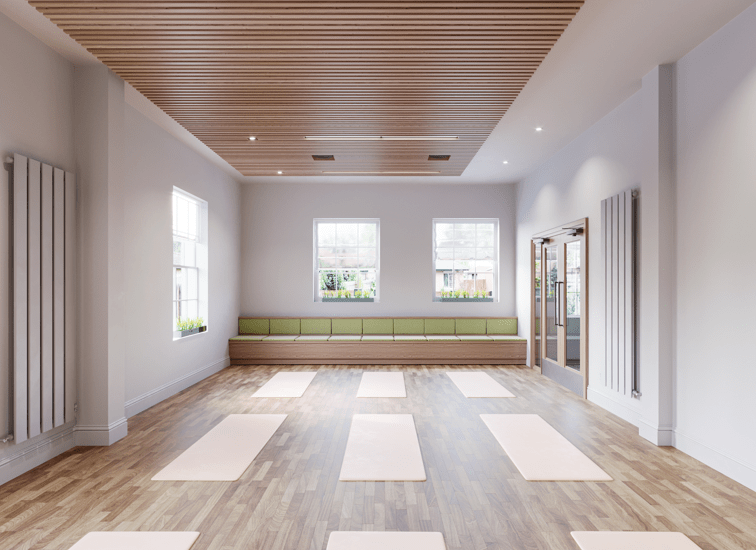
The Wellbeing Centre was a good venue to be held in as mats were laid on the floor for comfort and stability. The wellbeing space had also been utilised as the big screen on the far right hand side was there for clear instruction and calming and settling music to help get everyone in the correct mindset for the best well being experience.
Food and wellbeing :
The brand ‘Pulp Friction’ is a smoothie bite company that work with young adults with learning disabilities; they make smoothies from a traditional power bike, which is very good as it improves mental and physical wellbeing. As you are eating healthy smoothies you become more mentally healthy. Moreover, it improves physical wellbeing as you are riding a bike which is good, stable exercise which increases your fitness and puts you in better shape!
Their smoothies contain the following ingredients:
Frozen fruit including :
Strawberries,
Melon,
Grapes,
Mango,
Raspberries
The choice base for the smoothies:
Water,
Pineapple juice,
Sorrel cordial,
Raspberry cordial, Elderflower cordial, Fresh lemonade made with lemons and sugar
Music recital hall recap:
Salsa dancing was very exciting as it was held in the recital hall, this was very interesting as many people were excited and were participating, and the best part was that they didn’t need to have any kind of specialisation or past experience but they had a teacher who had all the basic skills needed. Salsa dancing was very interesting as the big board at the front was used to show everyone what to do and the music was also played there.
Salsa dancing highlighted freedom and fun and fast movements linking with the main goal of the day, wellbeing. This was received well by the students as it gave the students another chance to socialise and also another chance to liven up and let loose after a quieter session in the library and more.
Interviews:
Our two interviewees stated that the whole day ‘was about calm and relaxing activities, to better help them with socialising’. However, this wasn’t backed up very well – according to an anonymous Year 7 who told us that the day ‘wasn’t very good so far’ – but this was said when only two activities had been completed.
Mr Shabir :
Q: Favourite part of the day?
A: Crafting club because the creativity and how it is different to other clubs makes it definitely my favourite.
Q: How is this year’s 7 days different?
A: The whole day is different as the day is about wellbeing and it’s about different types of wellbeing being mental and physical well being which is something we haven’t done before.
Q: Would you love the activity day if you were the students?
A: Yes, because the day is very creative and mindful and is a good calming, relaxing way to end the week in a positive and optimistic way which makes me really relaxed overall.
Year 7 student :
Q: How have you enjoyed your day so far?
A: It wasn’t that good so far as all we have done so far was reading in the library but it was nice to get my mind of the stress of school and be free in my book.
Q: What did you do in the library lesson?
A: I read one of my favourite books and I learnt some new reading tips and ways to focus on my book and be comfortable where I am reading.
Q: What are you looking forward to today?
A: The food and wellbeing exercises because I’m hungry and would love to try the food!
Miss Davis (about craft club):
Q: Why is craft club good?
A: It brings individual talent together in one club and there is something for everyone.
Q: How does craft club correlate to wellbeing?
A: You’re away from your device and you’re interacting to help clear your mind and you have something to show after you long hard work like my knitted jumper I made that I am very proud of: it took me a very long time to make, but it was worth it!
Q: If you didn’t do craft club, what club would you do?

A: I would definitely do board games as I love something that interacts with your mental wellbeing and is a great space to enjoy some time with your friends, interacting with them which is good to have a break of the devices and it is generally just very fun to do.
Board games club:
Board games activity was very interesting, as it is a lot louder then the other activities we have previously gone to. It was good because it’s very social and compared to others like the library session, there are two teachers who were there to help others be happy. Moreover, it was a very optimistic happy space were friends can be very open with each other and allows them to feel free in their own space instead of the stressed, tight school day.
Interview on year 7s on board games activity:
Q: Do you like board games clubs and if yes why?
A: Yes, because it is fun and cool and all my friends talk with each other making everyone feel positive.

Q: How do you think board games help with your wellbeing?
A: They make people interact with each other and they are off their devices which helps my friends mental health making them a happier person.
Q: Is this a nice contrast between the other quiet activities?
A: Yes, because I am not interrupted and allows me to express myself freely feeling uncomfortable in front of everyone.

Craft Club
Craft club was one of the most well received activities as it was vibrant and fun where your creative limit was the sky. Many people were having fun drawing, painting and more, everyone was having fun and it was good to see everyone let loose, with the board playing soothing and calming music; this didn’t resonate with the pupils as everyone just had fun and drew!
Craft club interview on William in year 7:
Q: How have you been enjoying the craft club?
A: It is a good way to do productive work while relaxing and enjoying my time in a mindful space where I show my true colours in drawing!
Q: Do you think craft clubs help wellbeing?
A: He thinks it’s mostly for well-being and helps his mental health as he has taken all other stresses and worries away and is just peacefully drawing an amazing picture!
Q: What was your favourite club so far today?
A: My favourite club was the food and well being because it was nice to see what I have made and that I got a free smoothie which relaxes my brain and body overall.
Q: Are you enjoying the day and all the activities?
A: Yes, it is fun to do more free work but I would prefer to do normal lessons as I enjoy to learn more information and knowledge.
Activities Day at Nottingham High School
Board Games
On Activities Day at Nottingham School on the first of March 2024, Year 7 cycled around a wide variety of courses and activities to broaden their horizons.
We asked some of the Year 7s how often they played board games at home and received a wide variety of answers. Some rarely and some often and this could be seen in how much fun they seemed to be having playing the various board games on offer. However, the general feeling in the room was that board games were a great source of fun. The students were all enthusiastic and happy to share their opinions about board games to us. The activity was headed by Mr Johnson who explained the rules for each game to each group of students and also Mr Green and Mr Tan.
This group is playing a selection of games, in this photo they are playing the mind game, where they have to guess the number they have without talking.
Most of them said, “it helps us to communicate with each other”, highlighting the benefits of playing board games. They all looked quite enthusiastic and well focused on winning and getting to the next stage of the game, all whilst maintaining a sense of friendliness between one another.

This group was also playing the mind game where they have to get the number which the other person has to guess.
We asked them what they thought about the game:
“It helps us to socialise”

Mr Shabir playing exploding kittens with a group of students
Young Engineers Write Up
Young Engineers is a club that allows avid engineer lovers to explore building codes and building robots. It counts as a ‘Monday extracurricular activity’ and is held on a Tuesday lunch time.
Recently, the club is working in groups to build a robot with Lego Spike. They are programming each robot to complete different tasks. They try to get the robots to do the tasks on a first Lego league mat. The tasks they’re completing are part of the Masterpiece Robot Game.
Members of the club have said that the club helps them build problem solving skills and resilience when it comes to working out different codes and building the robots themselves. It is also a great opportunity to socialise with friends while doing something productive and beneficial.
Yoga Flexible space in the Wellbeing centre.
In this section of the Year 7’s activities day, they were able to do multiple stretches to enhance their breathing and concentration. The teacher, Lisa, was able to settle the class down to create a thoughtful and focused environment to be able to give the year 7 participants a cycle of different stretches from the, Table position on all fours, then into the Child’s pose (almost like a pebble position) then into a cow pose, which also added in the mooing, which they were able to engage with to get themselves and get active, and finally into a form of the cat, where they also give the sound of a cat, which also engages them.
Overall, the Yoga activity was an incredibly relaxing experience for the year 7s, calming them from the excitement of activities day and provided them with new knowledge regarding yoga and how to release their energy.
Food and Wellbeing in Food Classrooms 1&2.
Today, Year 7 had the opportunity to partake in the Smoothie Bike Challenge in the Food Block. Mrs Stafford headed this challenge, assisted by people from the organisation Pulp Friction who work alongside adults with learning disabilities or autism and empower them everyday with activities such as community meals on Thursdays and working at a police and firefighters headquarters.
The Smoothie Bike challenge is where students are permitted to go onto bicycles which when cycled blended the smoothie of the students’ choice. All of the students had the chance to take part in this fun activity and sampled the shake they had made as a result of it and all of the students made full usage of this opportunity, approaching the challenge with eagerness and a smile on their face.


Summary of the Day
In overall, with these 3 activities we were able to monitor, we were able to see the year 7’s develop in their communication skills, understanding their mental health, practising yoga to calm the mind and to enhance their focus and concentration and we were able to see their smoothie bike fitness put the test as well as the fun board games activity.
Year 8 activities day
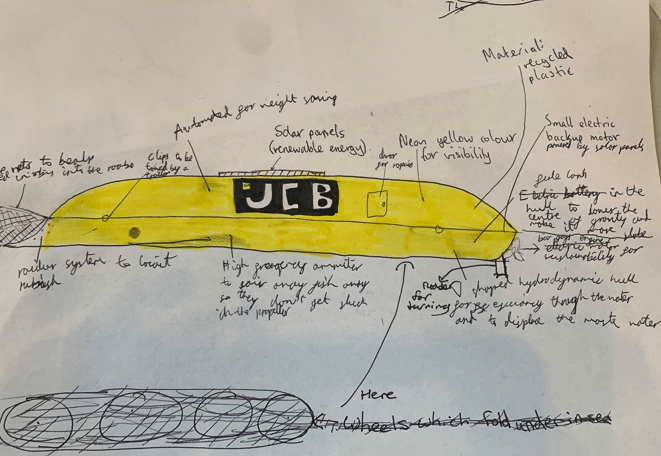
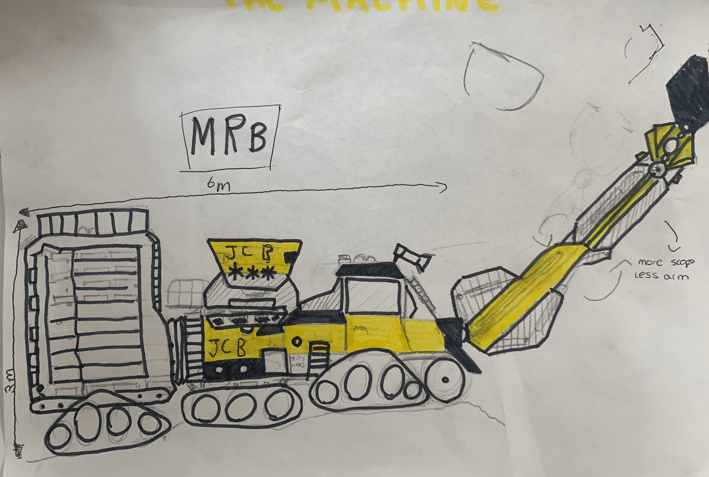
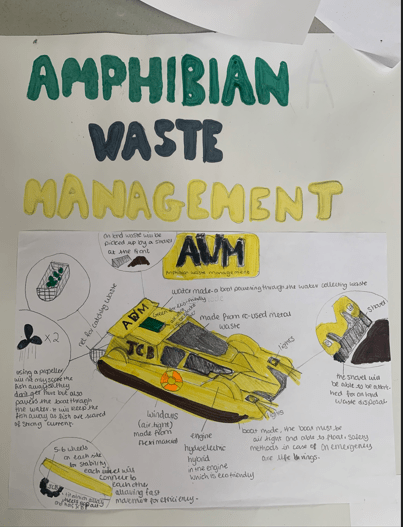
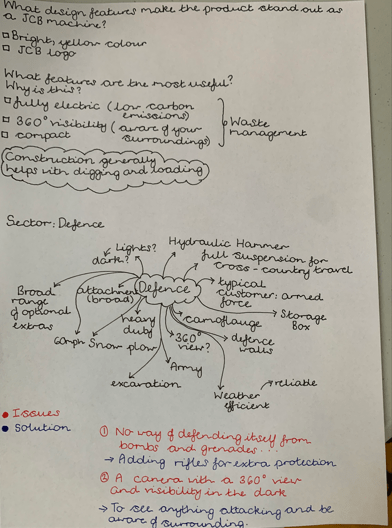
In the bustling Player Hall filled with the energy of eager Year 8 students, Caroline, the charismatic instructor of the National Careers Challenge, took charge of the activities day with a vision to foster leadership, communication skills, and a deep understanding of the challenges facing various sectors in the modern world. The students were tasked with developing a new vehicle focusing on one of the four major sectors (agriculture, defence, construction and waste management), providing students with a unique opportunity to explore new ideas and expand their creativity.
The day commenced with Caroline challenging the appointed group leaders to articulate why they were suitable for their roles. This exercise not only boosted their confidence but also honed their public speaking skills, as they addressed a large audience. The emphasis on leadership set the tone for the day, encouraging students to take charge and develop “essential, transferable skills for the future”, as Caroline told me.
The introduction of a video on different types of excavators served as a gateway to new information, sparking curiosity among the students. They were told that it is imperative to design machines with sustainability in mind, which added a layer of environmental consciousness, highlighting the responsibility of future generations to consider the impact of their creations. The students were presented with a challenge brief, allowing them to choose between construction, defence, waste management, or agriculture. This decision marked the beginning of their focused exploration into a particular sector for the rest of the day. The challenge was not just about design; it was about understanding the problems and proposing innovative solutions.
Throughout the day, the students worked in assigned groups, breaking away from their comfort zones to communicate and collaborate with new peers. Group leaders demonstrated effective communication and task delegation, ensuring that every team member knew their specific role. This experience not only promoted teamwork but also instilled essential skills for future interactions in various facets of life. In almost every group I came across, all the pupils knew exactly what part of the task they were focusing on. Further reinforcing this clarity, as the students delved into their tasks, help staff circulated to provide assistance where needed, ensuring that the tasks were completed effectively. Caroline’s clear communication and occasional interventions helped steer groups in the right direction.
The activities day was not without its challenges, however. One group experienced a barrage of irrelevant conversations and conflicts, which were skillfully resolved by their leader. In another instance, one student was not following the instructions and behaving poorly. Due to this, in her next intervention, Caroline addressed his behaviour in front of everyone, leading to a positive transformation in his attitude and commitment to the task at hand. Caroline encouraged students to embrace creativity, even in the face of potential duplication. Her words, “It’s about yours being the best and most unique,” motivated teams to think outside the box. The importance of innovative design ideas was reinforced through a video, challenging each group to incorporate at least one groundbreaking concept into their final machine.
Later in the day, the students were introduced to marketing and promotion skills, as they were tasked to develop either a poster, social media campaign, or information flyer, containing all of their research. These skills were further reinforced when the task of creating a commercial (song, radio advert, poem, acting scenario, etc) was added to their workload. This not only allowed them to develop their creativity and confidence, but also forced the group to spread the tasks evenly among themselves, which developed good teamwork skills.
Overall, the Year 8 activities day proved to be a dynamic and transformative experience for students, providing them with a platform to develop leadership skills, enhance teamwork, and apply creativity to real-world challenges. Under Caroline’s guidance, the day not only expanded their knowledge but also cultivated a spirit of entrepreneurship and innovation that will undoubtedly serve them well in their future endeavours.


What is the curiosity cabinet?
Well, the curiosity cabinet is a section inside our wonderful school, related to items which are on the topic of languages, (at the present time).
Inside the cabinet, we have some items such as a scarf, a book about Adolf Hitler and even just a little quote presented on a piece of paper. These all talk about the language, culture, tradition etc. For example, a book called ‘A la recherche du temps perdu’, this french book is written by Marcel Proust and links to the lack of meaning in the world and the time we have wasted. Another book, ‘ER IS WIEDER DA’ is a book written about Adolf Hitler, translating to , ‘Look who’s back ’it also shows how he starts his new career which is about to devastate the whole world. So we like to think that the curiosity cabinet is a section to express the feelings that have happened in the past or even the present and it changes every month to each department.

What is the aim of it?
The curiosity cabinet is a place where we aim as a school for each month for every department to fill the cabinet with things which are relevant to the department.The main aim is to bring the value of curiosity to every person in the school without teaching but using a visual.
What is the main importance of the curiosity cabinet?
The curiosity cabinet is there to motivate a person’s interests and cultivate their careers to invoke curiosity through the ability for yourself to cultivate your own interests, as if you, yourself are interested and fond about the subject, you will learn more and be successful. Where it is able to promote a student’s interest.
How does the school plan to expand on the curiosity cabinet?
The school plans to use each department’s main characteristics to produce another full cabinet of the ideas related to the department. This happens every month and it changes throughout the departments.
What do we think of this?
We believe that it is a great introduction to the schools main values as it engages students and helps capture our imagination and sparks new interests, inspiring the younger generation through your mind, rather than being taught it. This allows for you to be able to be more curious and to find your own passion. However, we believe that this is only just the beginning and more work will be done to improve and renovate this section of the school as it is one of the main values that are used in the school. We believe that we need to spark curiosity by giving a wider range of interests.
23.01.24

04.12.23
The wellbeing centre is the latest addition to Nottingham High Schools’ vast array of resources, with a new focus on students and members of the school community’s mental health. The new building holds certain areas which students can utilise and enjoy, such as the new-found Oasis room or weekly yoga sessions.
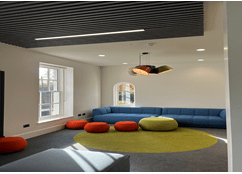
Prayer rooms are now also situated here, encouraging diversity and a spiritual space amongst pupils of any religion. It is also a place of reflection; where students can go before and after school, and at breaktimes and lunchtimes. With a dedicated team of support staff, there are teachers that can care for each and every one of your needs, with a particular focus on one’s individuality and health.
With dedicated seating areas, the wellbeing centre is perfect for those that need an area to de-compress and relax, or a passive listening ear for all of your problems, little or large.
04.12.23
BBC GOOD FOOD TRIP

photo credit: Sonam Soar
On Sunday the 26th of November, a group of Y10 GCSE students travelled to Birmingham to go and see the Christmas BBC Good Food show, led by Mrs Stafford and Mrs Turnbull. On arrival at the NEC, we had a quick round of all the stalls that were there, which ranged from artisan bakers to plant based foods, and a whole host of amazing dishes from all over the world.
Then came the time for the first live cookery show in the Big Kitchen – The Hairy Bikers. Despite David Myers being unable to attend, Si King made a great effort and delivered an amazing half hour of cooking. Among the jokes and amazing smells that went through the kitchen, he made a tomato soup with dumplings and also American style sloppy joes. Everyone enjoyed the first show, and we were all excited for the next.
We then had about 3 hours to browse around until the next show – the perfect time to do some shopping, get lunch and of course try all of the samples on offer. You could get duck wraps, bakery goods – even freeze dried sweets. Over 100 stalls were there, each one with something new and different from the one next to it.
At 1:45, we went to our second and final show of the day – Nadiya Hussain. She made an egg bhuna and a kulfi ice cream sandwich, both of which looked amazing. It was great to see the different techniques that she showed us, and also to see what variety each cook had to offer – Si King and Nadiya both having completely different styles, but both shows just as interesting as each other. Everyone was so excited to see her, and a great show was given on her part.
Overall, the BBC Good Food trip was a really special experience, and we would like to thank Mrs Stafford and Mrs Turnbull for such a great day.
10.11.23
SUPPORTING GURU NANAK’S MISSION
Every half term, Mrs Stafford and a group of our school community come together to support the Guru Nanak’s Mission Charity – one based in Nottingham with the aim to stop hunger and help the homeless.
Sikhism’s mission is to uphold equality, social justice, service for humanity and tolerance of other religions. At all times, the basic teaching of Sikhism is spiritual loyalty and reverence for God while practising its ideals of honesty, compassion, humility and generosity in daily life. The ten Sikh Gurus were the first ten leaders of Sikhism, founded in India. They include Guru Nanak, Guru Angad, Guru Amar, Guru Ram Das, Guru Arjan, Guru Hargobind, Guru Har Rai, Guru Har Krishan, Guru Teg Bahadur, and Guru Gobind Singh. The GNM (Guru Nanak’s Mission) initiative is a community project aiming to provide food for all who need it. The GNM was founded on the teachings of the first Sikh Guru, Guru Nanak Devji; ‘langar’, (translating to ‘free food kitchen’), equality and justice for all. Guru Nanak once said “with the grace of the Lord, whatever you have received, share it with the needy and then consume.” – a concept which is used by the Charity in an amazing way.
In an interview with Mrs Stafford, we saw some of her views on the fantastic work this Charity does, and how she and a team from our school community do their bit. Different year groups are selected so that a wide range of students get the chance to contribute to the cause. Vegetarian meals of chillies, bolognaises, and tagines are cooked by Mrs Stafford and her helpers and are later served on Albert Street that evening by the helpers of GNM and our schools Community Action. Most recently, a group from Y10 were selected, and cooked many portions of a vegetable tagine. Mrs Stafford, when asked why it was so important, said that it was always nice to help a local charity as it was a humbling experience, and was a nice moral act she could do with her helpers. When asked for future plans, it was said that possibly on the 9th or the 10th of December, a Christmas theme would be put into place to support GNM. A vegetarian chilli or a bolognese is on the cards, as well as some chocolate hampers and toiletry hampers which will be supplied and put together by some members of 6th form.
We can see what incredible work has been put in by Guru Nanak’s Mission and Mrs Stafford (plus her helpers!), and the results are clearly shown by the hundreds that have a hot meal for the night.
Gardening club! 02.10.23
Gardening, known for its therapeutic effects, has become a cherished activity for young NHS pupils. The act of planting, nurturing, and watching something grow is a calming and rejuvenating experience, especially for students juggling the demands of a rigorous education. It offers a unique opportunity for them to unwind, connect with nature, and take a break from the digital screens and mobile phones that dominate their lives, from the calming atmosphere of the front lawns.
Mrs. Andrews, the dedicated teacher in charge of the club, has been instrumental in its success, with many pupils every year, aimed at getting new year7s to join, heading down to enjoy it.
I asked one student about his experience at gardening club, and he believes it is a great way to get away from the business of school life and constant assignments, and take the opportunity to grow something.
You can go to Gardening Club on a Wednesday Lunchtime, and it is open to students of all year groups, to grow what you please, and take in some sunlight!
Geography talk about aid. 02.10.23
On September 25th, I attended a virtual Zoom lecture by University of Portsmouth lecturer Dr Lana Chikhungu, senior lecturer of/for international development, targeted at A-Level Geography Students. The title of the lecture was “Rethinking aid and development in the Global South: Does aid really benefit the beneficiary?”, which Dr Chikhungu said was one of the topics for her course at U. Portsmouth.
The lecture began first with trying to define aid and the “Global South”, then with a brief history of global aid. The most important point of this section was the Marshall Plan, which Dr Chikhungu painted in a new light by suggesting that it may not have had a major economic impact in the post-War world, but was rather a form of steering countries in Europe towards a more anti-communist approach to their government and foreign policy. She cited the following article by Paulina Restrepo-Echavarria and Brian Reinbold:
https://www.stlouisfed.org/on-the-economy/2021/july/marshall-plan-not-key-to-europe-reconstruction
She then went on to describe what has shaped the history of aid; namely, the Cold War, geopolitical motives, and colonial histories. For example, Dr Chikhungu told us that from 1970 to 1994, the UK and France directed most of the aid to former colonies, while non-democratic former colonies on average received two times more aid than democratic non-colonies – this is a fact that, while I had some knowledge of already, I found particularly striking.
She then taught us about the DAC (Development Assistance Committee) and OECD (Organisation for Economic Cooperation and Development), and the role that they have played in the shaping of global aid in the late 20th century. In this segment, we learned that each member of the OECD was expected to contribute 0.7% of their GNP, and that only 6 out of 28 member states managed to reach this target. They were the Netherlands, Denmark, Luxembourg, Norway, Sweden and quite narrowly, the UK. Dr Lana then got us to discuss and think about why this was the case; eventually, we came to the conclusion that what they had in common was that they had little-to-no colonial history (except the UK and perhaps the Netherlands), they were not interventionist and they were either Scandinavian countries or smaller countries with high GNP/c’s.
At the end of the lecture, Dr Lana Chukhungu closed with telling us about the role of NGOs (non-governmental organisations) and different contemporary economists who had differing opinions on whether global aid was effective or not.
I particularly enjoyed the lecture; I learned a fair bit, and engaged in keen discussion with the A-Level Geography students, as well as Mr Brown and Mrs Lemon who also attended the lecture. It was a 45-minute lecture meaning we were slightly strapped for time, so I would have liked it even more if Dr Chukhungu had gone into more detail about the political effects of global aid in the 21st Century, for example with France in its former colonies. However, I still thoroughly enjoyed the lecture and believe that this is a topic worth looking more into!
Clubs starting this year. Our reporters have been looking at different clubs this week and putting some reports together on what the school has to offer at lunch. Here is a selection
25.09.23
Art homework club
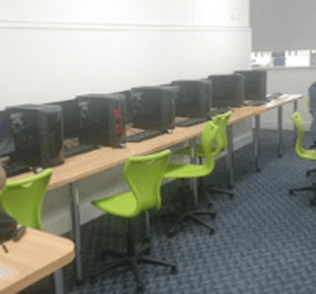
Homework club run by Miss Riley on Wednesday lunchtimes is a club where students can bring in homework of any kind and sit and do it with friends. Although it is preferred to be art since it is an art room and there is an art teacher there to help. If you do not have any art work then you can just do homework for any other subject. There is a nice atmosphere where students can talk to one another and do work and help each other.
Pottery Club
Pottery club is on a Monday lunchtime run by Miss Kirbyshire and Mrs Lachetta the art technician. Here you can explore your interests of creating different types of ceramics and pottery. This school is very lucky to have lots of clay and machinery to make this club possible and I would definitely recommend going and taking advantage of the rare club. You can create stunning pottery to your desire and will eventually be able to take it home. You can follow designs and try to replicate existing pottery using this machinery. After sculpting your pot the teachers will glaze it for you.
Electronics club
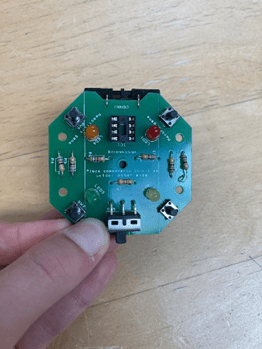
is available on a Thursday lunchtime, offering a wide range of activities which you can do to spend some time on and have fun with. The club is available to year 8s, 9s and 10s and allows for the exploration of Design Technology. New attendees will take two sessions to be re-introduced to soldering (this being the main focus of the club) by leading production of a circuit and its casing. After this crash-course, attendees will be given more freedom on what they will spend their time on as the clubs run with there being a variety of different circuits to solder ranging from xylophones to mini hand-held games. Alternatively, you can use the time and space in Electronics Club to pursue CADCAM, 3D printing, electronic textiles, lego or even catch up on some classwork from the subject you’ve left for later. Mrs Anderson is always happy to help with any projects however, if not needed, you can simply work independently and have some down-time during lunch. Seeing as the club is available to multiple years, there may be some lunch clashes however Mrs Anderson is happy to entrust the responsibility to eat a Grab-and-Go or a packed lunch inside the club, provided you’re not messy about it. Overall, the club is a good place to develop your DT skills and is a really nice way to add on an extra task for your High School Award or spend a few months in for DofE. Equipment is limited and so only 16 members can arrive so if you do decide that you would like to be a part of this wonderful club, you must email Mrs Anderson first regarding any remaining spaces.
One of the various projects you can undertake at the club – a handheld Simon game in which it flashes a specific order of lights and you must input the same order.
Esports
At esports students can come along on a Wednesday lunchtime and play rocket league, which is basically like playing football with cars. They form teams of three and set up matches.
They also have a school team who play on the British esports champs every Wednesday after school.
As well as this, there is also a sixth form team who play Valorant which is a team shooting game for older students that are 16+.
Esports is a fantastic opportunity to meet new people from different year groups as well as developing skills such as teamwork, strategy and critical thinking while having lots of fun!
Mrs Higson welcomes any newcomers who have varying levels of experience gaming so anyone can come and have a go- regardless of skill.
Drama Club
On Wednesday, I ran a drama club for Year 8s with a friend. The Year 8s were very enthusiastic and energetic, which was really nice to see. Around 19 people came to the club, which was ideal for us, as we were able to do a variety of games. We started with a game of splat and this was a favourite among the Year 8s. They thoroughly enjoyed being the ‘splatter’ and it was an exciting starter game of focus and pressure. After we had a few rounds of splat, we moved onto a more ‘drama-focused’ game. My friend and I decided to play a game where we call out a number and an object and the Year 8s would have to get into groups according to the number and make the object. The game got them to use their bodies and think about where people could go to make the object believable. This was enjoyable for the Year 8s as it was a competition to see who could make the object the best. The Year 8s were very keen to make the best object and would explain to my friend and I why they put people in certain positions/places. Following this game, we asked the Year 8s for their input on the next few games and they were all very eager to contribute. We got some great suggestions like ‘duck, duck, goose’ and ‘wink, wink murderer’. In addition to these suggestions, we also had a few suggestions for repeats of previous games. My friend and I then decided to play wink, wink murderer and a lot of the Year 8s were passionate about being the detective or the murderer. The Year 8s were also instructed to ‘die dramatically’, which got them to think about the drama skills they have learned in the past year. In conclusion, we wanted to make the first drama club a lot of fun for the Year 8s but we also wanted to balance it with drama skills, so that they could use the skills in their lessons.
Written by Lucy Minto
Visit from the council. 20.06.23
On the 24th May, 3 workers from the Nottingham City Council came to the High School to deliver a talk on how the city for Nottingham is revamping its Cycle, walk and bus routes for the future, and how we can improve them and build for a newer, more sustainable future.
Cycle routes in Nottingham
Its estimated that 100,000 people that live in Nottingham own and ride a bicycle every year- meaning that we are already on the way to delivering a viable future and encouraging children, teenagers and adults to ride bikes and switch from gas-guzzling cars, helping reduce the pollution that fills the air that we breathe. There are over 650 miles of countryside that we can use daily, however the plans that the workers at Nottingham City Council outlines show that we are planning to integrate it into our daily lives- cycle routes and paths will now become commonplace, and by 2025 we will be laying and installing cycle routes across multiple of main roads.

This will ultimately try to have the desired effect of getting more people to use bicycles on their commutes to work or school, and fighting the obesity crisis in England by getting people to be healthier and be more active. In addition, people will be able to start using their bikes safely and across further distances- the council are planning to create more routes that can stretch all over Nottingham- allowing for more citizens to have greater, longer-distance travel. Furthermore, we will be ranked in the top 10 of cities in England that have the most cycle routes by distance covered, allowing for us to be able to rise in the rankings, and push for a nationwide effort to improve sustainability.
Buses in Nottingham
According to the Nottingham City Council, Nottingham has the second highest number of buses used citywide in the country outside of London, and the Council are doing nothing less than attempting to improve usage and sustainability. For example, recently Bulwell Bus Station was reopened at a ribbon-cutting event by an Olympic athlete with remarkable renovations following a period of being “unappealing to look at and difficult to use”. The renovations and additions included new solar-powered lighting, better accessibility for wheelchair users and other disabled people, and new plants in order to increase biodiversity. This has been done as part of the Transforming Cities scheme, which the council workers also talked about on the day. The £161million scheme oversaw/is overseeing radical improvements to both cycling and bus usage in the city and wider urban areas of Nottingham, such as improvements to the real-time displays, changing bus lane and traffic light priorities for buses and cyclists and announcing plans to extend the “£2 on all single tickets” scheme up to October of this year. Perhaps most importantly, we were told about plans that were still in development to begin switching buses from diesel/petrol to electric, in order to make Nottingham more environmentally friendly and bring the city closer to their goal of reaching net zero carbon emissions by 2030. All in all, the talk was incredibly informative and insightful, and we at Nottingham High School thank all of the workers for taking their time to come in and talk to us about our city, what they’re doing to improve it, and what we can also do to be more aware.

Wellbeing centre
20.06.23
Many of us will have seen the construction going on surrounding the White House over the past few weeks. This is in anticipation of a new wellbeing centre to support students in a number of ways.
Wellbeing is particularly important in school years as we navigate through the many changes and difficulties that come with growing up. Additionally, the ever increasing prevalence of social media in our lives brings about its own issues and pressures as we begin to see certain standards and trends influencing our mental health. Everyone has times when they don’t feel 100% and the hope is that the wellbeing centre can support students in all aspects of their school career as they transition into adulthood.
To find out more about the wellbeing centre, we spoke to Miss Gritti about the plans for the centre and here’s what we gathered.
The SMT has been working really hard to make it an enjoyable space for all students, and it will hopefully open in October 2023, but it is still in the process of being built. It is expected that many staff will be situated there to help out students, including: Mrs Smith, Mr Glarvey, the school counsellor, school nurse, and a wellbeing centre administrator. It will be available to students from all years, as well as infant and junior school students and is open throughout, so students are welcome at any time.
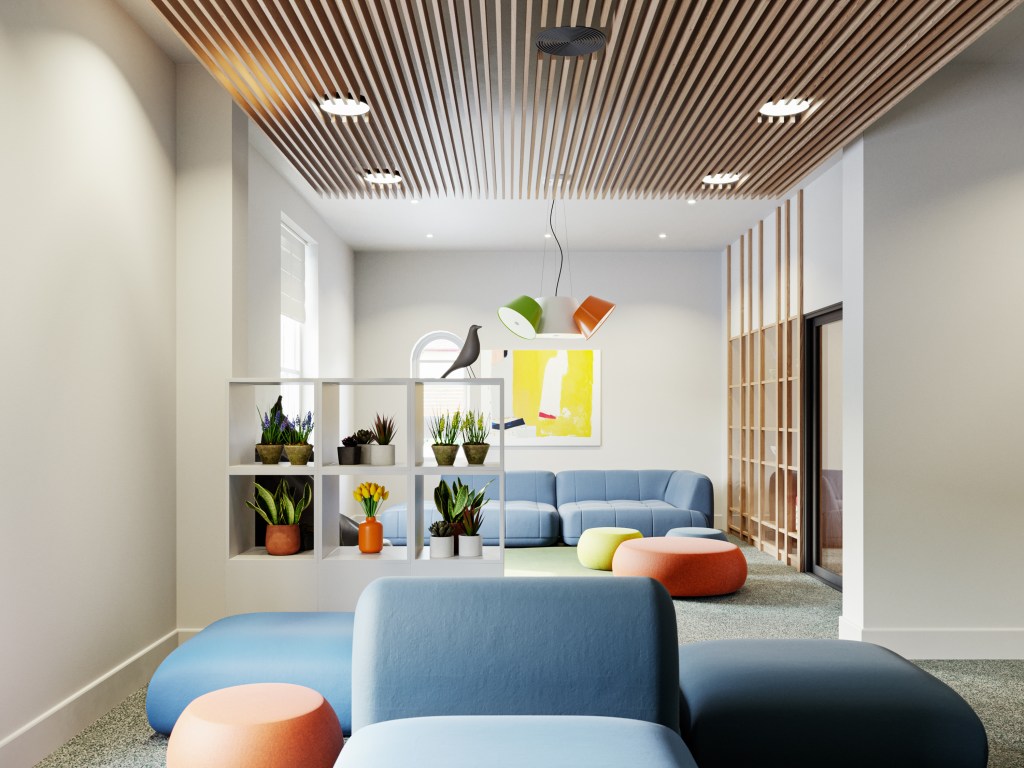
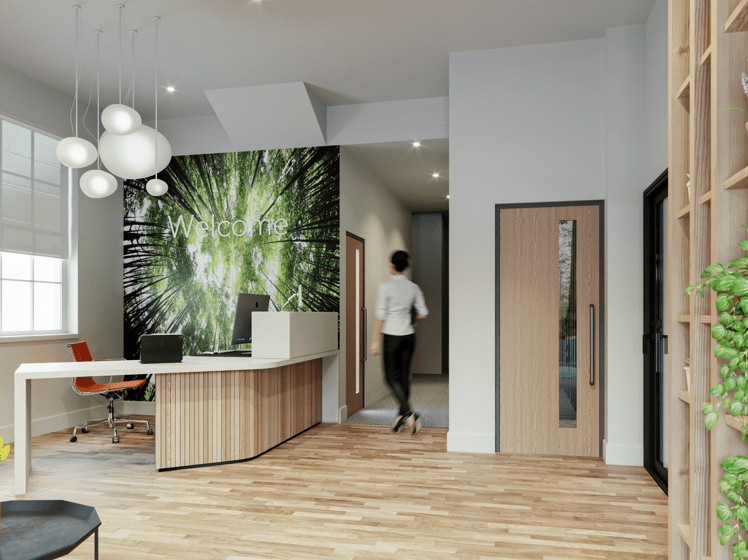
This new wellbeing centre is expected to be a completely different space to everywhere else in the school with the aim to help students in a number of ways. There will be an oasis room, where students can have quiet time to relax and a spirituality space for students to reflect and pray. The garden has sensory elements and there will be a peaceful place, yoga studio and mindfulness space. The wellbeing centre is seen as the next step for the school’s wellbeing strategy however, it’s not a place that is just dedicated to mental health; there will be physical rehabilitation spaces and physio for students as well. Many school clubs like chess club will be relocated there. Certain stigmas surrounding dedicated spaces for mental health have also been considered; however with the wide range of activities and people who will be in the centre, the hope is that every single student will have a reason to go there at any time.
Year 10 Transition
12.06.23


The transition between years 10 and 11 is not an easy one as we see more pressure on mocks and exams and begin to experience some aspects of sixth form life. The transition has already begun with the moving of tutor sets and the starting of some of the year 11 activities like language speaking sessions. To gain some advice for current year 10s on navigating the transition between years 10 and 11, we spoke to some members of the sixth form team and here’s what we gathered.
One of the most important things to bear in mind is to never keep problems secret. The most successful students are those who talk to someone at the first sign of trouble. The sixth form team are really excited to get to know everyone and really stress the importance of talking to them if there’s any issue, no matter how small or weird.
Another key area of year 11 will be exams and managing exam stress. Work consistently throughout the year and don’t leave revision until the last minute was one of the most crucial bits of advice regarding exams. If you have any questions about work, speak to the teacher as soon as possible rather than waiting. It’s important to have a healthy routine every night after school. It’s beneficial to set time for work, but also to have other things like exercise and downtime to yourself or with your friends.
The sixth form team advised year 10s to take advantage of our long summer break and relax, go on holiday and have a break from school life because it’s important that you come back into year 11 ready and well-rested and recharge your batteries. However, you should also take this time to keep on top of your notes from year 10, fill in any gaps in your knowledge, and get ready for year 11. Don’t worry about revision this early on because you don’t want to burn out before the end of year 11. This summer is also a good opportunity to get work experience, but it can be difficult to find any because of your age and it is not essential this year.
In order to make their transition into year 11 easier, the year 10s have already moved into their senior tutor sets. It would be useful for you to get to know the year 12s and ask for any tips or advice they might have to help you along your journey in the next few years.
Whilst this may seem like a lot of information and advice, the most important thing with regards to summer is to have a well-earned break and not stress out too much, returning in September with a fresh mindset. Lastly, it’s a good idea to get to know the sixth form team as they are really excited to get to know us and help us in the next stages of our journey at school.
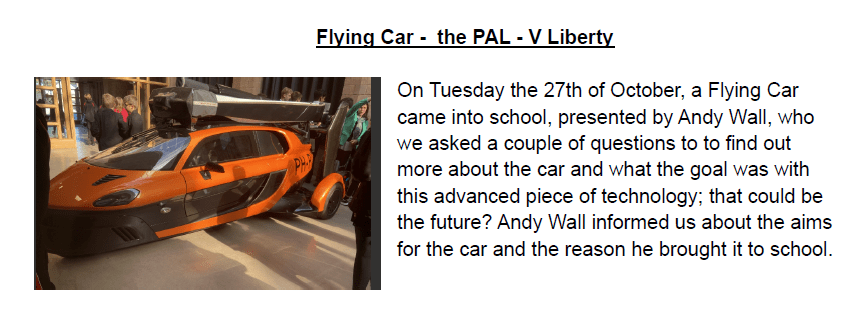
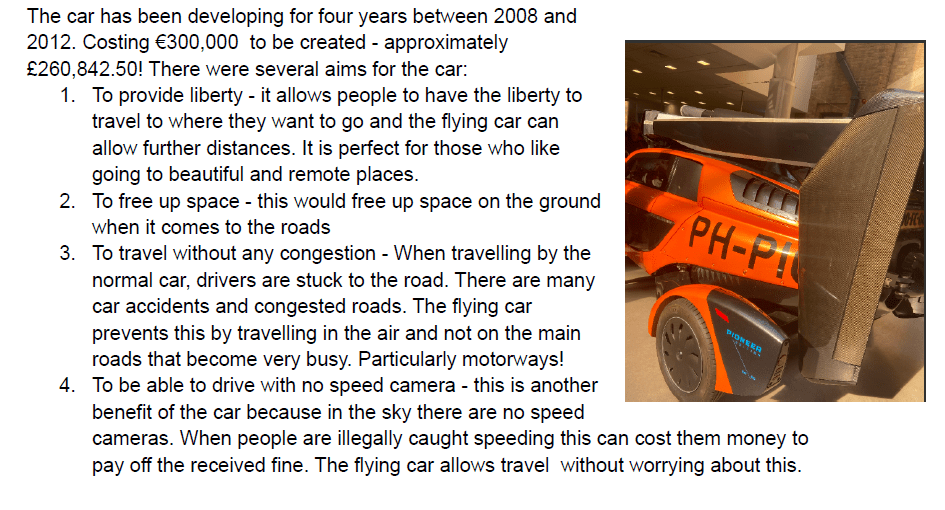
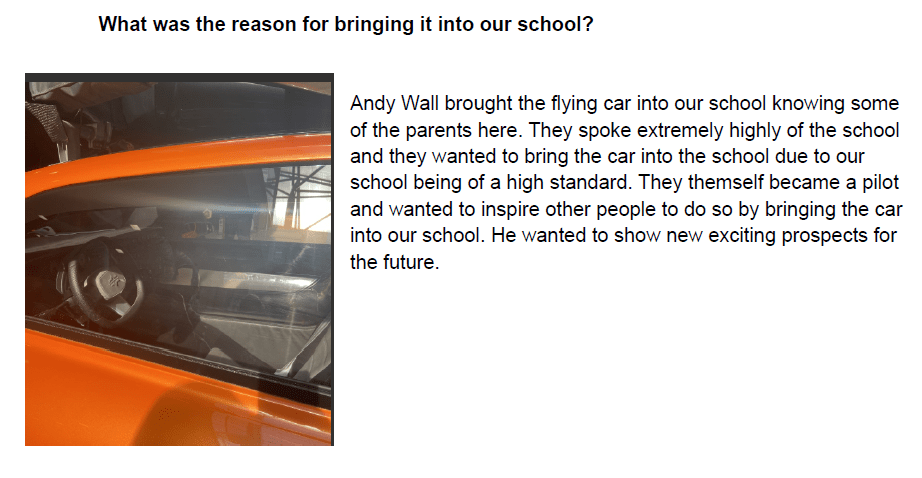
Flying car 14.11.22
What do students in year 10 think about spaces at lunch?
May 23rd 2022
This week we went around school (mostly year 10) and asked how students felt about spaces around school and how they can be used at lunch. The overall sentiment was a bit mixed with some saying there are enough spaces and some saying there aren’t. Most of the responses agreed there aren’t enough spaces as certain groups take up whole form rooms and are too noisy and crowded. Therefore, they have to resort to using places not meant for social spaces such as the corridor, music block, art block or library. However, in some of these places tend to get asked to leave and have to go outside where they get bothered by other years. Some people in our year though are content with our current spaces and ‘just chill in the form room playing on [their] phone.’
Some suggestions they had to improve this was to have a computer room open at lunch times so you could do admin tasks or relax there. Another improvement was a better grass area that was less restricted on the things you can do. E.g. ball games. One other one was to have a common room area with sofas that are dedicated for socialising.
In terms of clubs they found that there were plenty of them but most of them were only for years 7-9 meaning they couldn’t go in their view.
Circus session at Nottingham high school report
09/03/22
On Friday the 4th of March, various circus performers from https://projecthoop.com/ ran a taster session in the Old Gym for Year 7-10 students.
This included activities such as:
Hula Hooping
Stretch and Contortion
Juggling
Unicycling
Stilts
Various other circus activities
We popped in for a try of some of these- and found it quite fun and interesting, but we found some activities particularly difficult such as unicycling and walking on stilts. Here are some of the images from the day:


Interview with School Counsellor
‘A problem shared is a problem halved’. What people don’t tell you about clichés is that they are often true. This does not break the rule. Ever felt like all you need is to sit down with someone trustworthy to discuss a niggling issue? Mr. Hawes is here to help!
Mr. Hawes, the school counsellor, says that there are three main criteria of problem that people come to see him about. The first one is academic stress – one which we think the vast majority of readers can relate to. Overwhelmed or anxious about work? He’s your man! The second problem is linked to family life. Perhaps parents are overly strict or often getting angry. Or perhaps they are going through a divorce. These are all things which many young people experience, and it is important that feelings can be shared in order to maintain a positive mental attitude. The third one is based upon friendship issues, including bullying or things like falling out with people.
Mr. Hawes believes that what he terms ‘talking therapy’ is one of the best ways to deal with such issues. Talking with somebody about your problems relieves you of a load and it can often be beneficial to feel that you are being listened to. Mr. Hawes is not intensely involved with the school curriculum or teaching programme and so conversations with him are ensured to be confidential.
Mr. Hawes finds importance in the term ‘emotional fitness’. Emotional fitness is, as he puts it, ‘being able to exercise your emotions.’ This involves working through emotions and an ability to control and understand them. Just like with physical fitness, the more you exercise this, the fitter you become in this area.
You may be reading this thinking you are above this or ‘what will my friends make of me?’ Mr. Hawes believes that although this is an ongoing problem, more and more students are finding the courage to go and talk to him. He finds value in trying to normalise talking about one’s problems and does not think that being seen going in or out of his room (which incidentally is located outside M12) should be seen as a bad thing – quite the opposite.
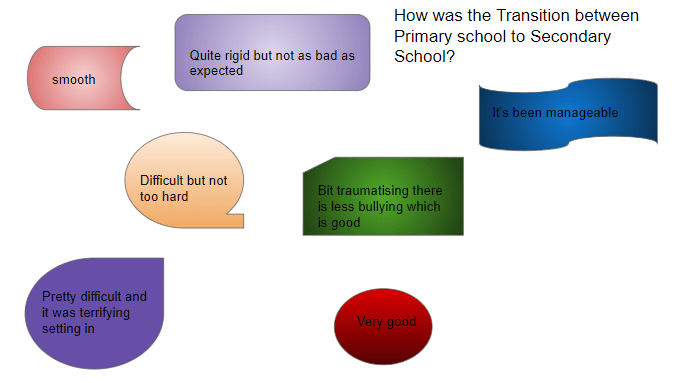
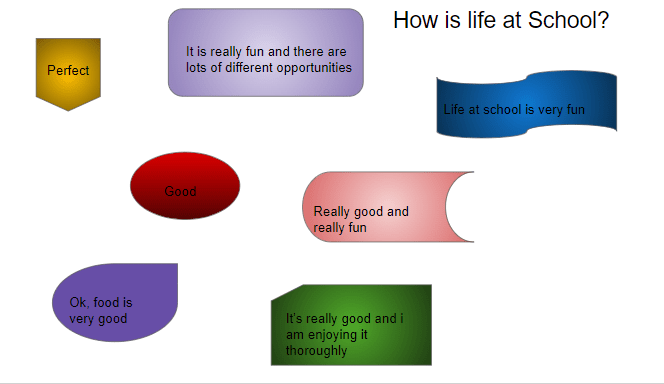
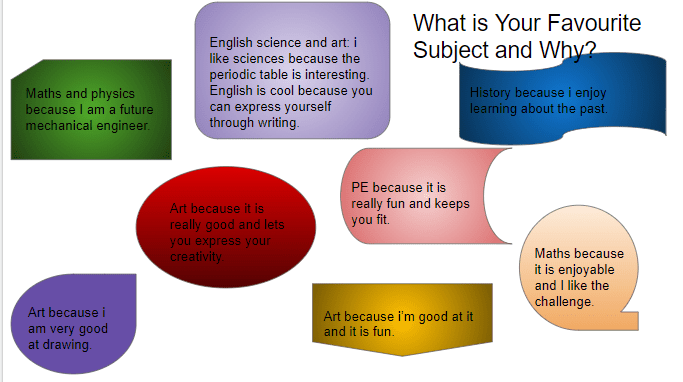
We asked year 7 a series of different questions about settling into school life…
The Year 9 Hockey A team
At Nottingham High School, we have had some very successful results over the past few weeks from all years playing hockey at different locations. Today, we are focusing on the Year 9 Hockey A team. During the small amount of time that we have played hockey, we have managed 2 draws, 2 losses and 2 wins. This includes the team progressing to the next round in the National competition.
So far this season, the team has had a decent start. We have played some good hockey and have good team spirit amongst the players.
So far this season we have been coached by Mr Read and Mr Croft, who are both very qualified and experienced coaches. Without them, we wouldn’t have achieved what we have so far and what we will achieve in the future. So far the list of teams that we have played, (in chronological order), are: Worksop College, Denstone College, West Bridgford, Worksop College, Toothill and Loughborough Grammar School.
So far this season we have trained on Tuesdays and had Games lessons on Thursdays, and played our games on Saturdays. The county championship that we took part in was on a Monday, which meant that we had to miss some lessons. We have a decently simple way of playing. We press, attack as a team and work hard in our defence. We have 4 defenders, 4 midfielders, 2 strikers and the goalkeeper. I asked my fellow teammate Michael Syme- Grant about what his thoughts were on the formation that we play. He said that “ the A formation is largely suitable, the system works for us as a team, especially when going forwards. One thing that could be improved is that the midfielders could drop back a bit more to help the defenders when we are under pressure”.
Overall, I think that, based on what we have done so far, the future is promising. If we can be a bit more clinical and stronger in the first half, we have a high chance of winning most games that we play. Everything that is needed for a successful team is there, we just need to use it every single game, for the full amount of time. We have the potential to achieve a lot this season. Good luck to the team!
Interview with Mr. Ramsey, Director of Finance and Operations at Nottingham High School
An environmental group was set up at the start of the academic year to combat the concerns that the school had over its environmental impact and to allow current momentum about sustainability to be conserved; not least after seeing the impacts of the Cop-26 climate briefing. Currently, only Em Abbott (yr.10) and Muskan Goyal (yr.11) represent the student group at the meetings. They want your help…
Set up by Mr. Ramsey ( Director of Finance and Operations at Nottingham High School), this ambitious group’s main areas of focus lie in 6 types of environmental impacts which the group has linked into three separate strands. These are: food and waste; carbon and transport, and construction and green spaces. Awareness of the environment has hugely increased in the last decade, making it one of the most involved and important challenges of the modern world. But is talking about the matter and talking about it some more making a difference? Not according to Mr. Ramsey, who was keen to point out the impact of tackling the problem practically – as they say, actions speak louder than words!
For example, there are 55% LED lights in the school as of December 2021. The group has set a target of reaching 100% LED bulbs in school as soon as possible. But Mr. Ramsey believes that all this effort will be redundant if pupils continue not to turn off the lights in rooms which they are vacating – something he thinks is a recurring problem. As he put it himself ‘There’s no point [in reaching 100% LED lights] if people don’t learn to switch the lights off!’ Perhaps active environmental thinking needs to be introduced to the school curriculum to train students to perform such tasks automatically on a day-to-day basis. This is one of the groups biggest goals – aiding the implementation of a basic environmental behavioural approach rather than just an attitudinal approach without action.
Another area of focus for the group is reducing the school’s carbon footprint, which as in 2021 stood at just under 1 tonne per person (per annum). Bearing in mind that nobody was in school at all for the first couple of months of the year due to lockdown, it is no exaggeration to suggest that this figure stands much higher. Simply raising awareness of the problem will not be fruitful in the long term; instead, students need to make sure they put litter in the correct bins and close the windows when appropriate.
A final reflection of Mr. Ramsey’s was that he believes that people will look back in 10 years’ time and think ‘why were they doing so little back then?’ He therefore views the group as something which could be impactful in the long term. For this reason, wouldn’t it be great to become a part of the organisation? Any initial questions or ideas, including about joining, should be directed at Mr. Alexander, whilst other members of staff involved include Dr Linton, Mr Willis (estates), Mrs. Auterson, Mr. Mantell and Miss Hale (internal communications)
By William Harwood and Charles Prestwich
 journalismnottshigh.com